


Identify debridement coding myths by auditing documentation, CPT usage, and payer guidelines regularly. Correct them by aligning codes with wound depth, method, and medical necessity, and seeking expert billing support when needed.
5 Debridement Coding Myths That Are Slowing Your Payments
Myth 1: All Debridements Are Coded the Same
Myth 2: Time Determines Coding
Myth 3: Only Surgical Debridement Is Billable
Myth 4: One Code Covers Multiple Wounds
Myth 5: Diagnosis Codes Don’t Impact Payment
In wound care billing, debridement coding myths can quietly drain your revenue cycle.
In fact, incorrect coding and documentation are behind over 70% of wound care claim denials, according to recent industry data. These myths don’t just cause delays — they lead to underpayments, audits, and unnecessary administrative work.
What Is Debridement and Why Accurate Coding Matters?
Debridement is the process of removing dead or damaged tissue to promote healing.
This can be implemented by using several methods:
- Surgical
- Enzymatic
- Mechanical
- Autolytic
Each technique has its own coding rules according to CPT guidelines, and reimbursement depends on accurate documentation—especially concerning the depth of tissue removed and the size of the wound.
A single coding error here can delay payments by weeks.
Worse, repeated mistakes can trigger audits or long-term reimbursement losses.
5 Debridement Coding Myths That Are Slowing Your Payments
Myth 1: All Debridements Are Coded the Same
Fact: CPT codes differ by both technique and tissue depth. For instance:
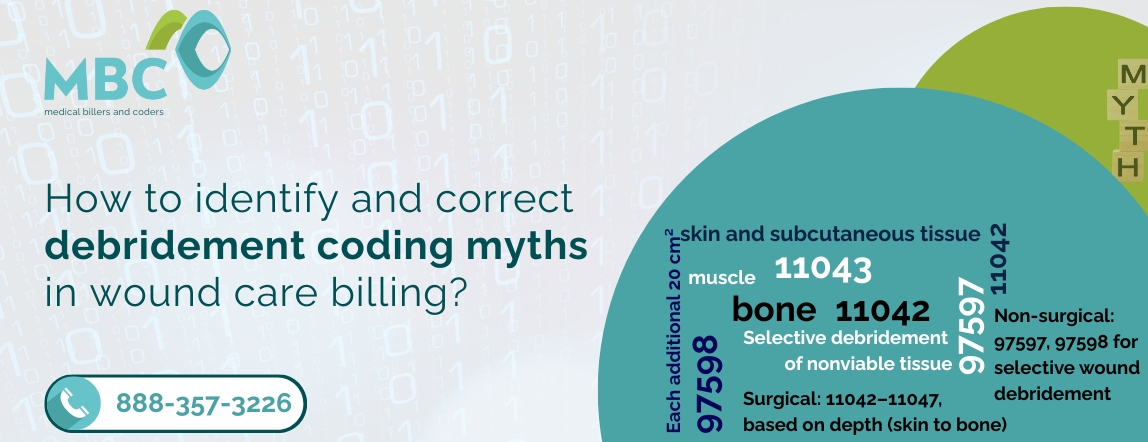
- 11042 covers skin and subcutaneous tissue
- 11043 involves muscle
- 11044 includes bone
Billing all debridements under a general code is a top reason claims are denied or downcoded.
Myth 2: Time Determines Coding
Fact: Debridement codes are not time-based. They’re determined by wound size and depth.
Many practices misapply time-based E/M rules to debridement. This results in automatic rejections by Medicare and commercial payers.
Myth 3: Only Surgical Debridement Is Billable
Fact: Non-surgical methods are billable — but only with the correct CPT codes:
- 97597 – Selective debridement of nonviable tissue
- 97598 – Each additional 20 cm²
Skipping these codes leaves thousands in unclaimed revenue on the table.
Myth 4: One Code Covers Multiple Wounds
Fact: Each wound must be coded and documented separately if treated individually.
When billing for multiple wound repairs:
- Additive Lengths: For repairs in the same anatomic area and complexity (e.g., simple, intermediate, complex), you should add the lengths of all wounds together and report a single code based on the total length.
- Different Complexities: If wounds have different complexities (e.g., one simple, one intermediate), you should code each separately, appending modifier -59 or XS to indicate distinct procedures.
- Anatomic Considerations: Wounds in different anatomic regions (e.g., arm and leg) can often be billed separately; again, use appropriate modifiers.
- Documentation: Always document location, size, and complexity of each wound clearly in the medical record to justify coding and payment.
Tip: Payers may have specific policies about bundling, so check individual carrier rules and NCCI edits before submitting claims.
Payers expect to see:
- Clear documentation of wound location
- Modifiers like 59 or XU when multiple wounds are treated
Bundling everything under one code? That could cost you 30–50% of reimbursement for additional wounds.
Myth 5: Diagnosis Codes Don’t Impact Payment
Fact: ICD-10 diagnosis codes must support medical necessity. A mismatched diagnosis code is one of the top reasons for:
- Payer denials
- Medical record requests
- Delayed reimbursements
Always align your CPT with the appropriate wound etiology — pressure ulcer, diabetic ulcer, venous ulcer, etc.
How These Myths Hurt Your Bottom Line?
Still relying on outdated coding beliefs? You’re risking:
- Denials: 1 in 5 wound care claims is denied due to coding errors.
- Underpayments: Up to 25% less reimbursement for miscoded debridements.
- Audit Triggers: Incomplete documentation and incorrect modifiers flag audits.
- Increased Admin Time: Teams spend an average of 18 minutes per denied claim just on rework.
Best Practices for Accurate Debridement Coding
Want to fix it? Start here:
- Comprehensive Documentation: Note the exact wound size (length x width x depth), anatomical location, and tissue layers removed.
- Use the Right Codes: Reference the latest CPT and ICD-10 coding guidelines. Never rely on memory or past templates.
- Don’t Bundle Wounds: Separate each wound and apply modifiers as needed.
- Stay Current: Payer rules and LCDs change often. Schedule quarterly coding audits to catch new requirements.
- Work With Experts: MBC’s wound care billing team delivers 98% coding accuracy and 15% faster reimbursements on average. Our Dedicated Account Managers provide proactive support to reduce denials and increase revenue.
Final Thought
The truth is simple: Coding myths lead to payment delays.
But by clearing them up and aligning your coding with payer rules, your wound care team can unlock more revenue, avoid audits, and shorten your billing cycle.
Schedule an audit today to uncover coding gaps, reduce denials, and optimize your wound care billing performance.
FAQs
Surgical: 11042–11047, based on depth (skin to bone)
Non-surgical: 97597, 97598 for selective wound debridement
1. Wound, burn, or infection site.
2. Depth of tissue being debrided.
3. Instrument used.
4. Removal of devitalized or necrotized tissue.
5. Mechanism of debridement.
Yes, you can bill for multiple wounds treated in a single visit, but it’s essential to follow CPT and payer guidelines carefully.
No. Coding is based on wound size and depth, not time.
They support medical necessity. A mismatched diagnosis code can lead to denials or audits.
