




Time-based anesthesia billing isn’t just complex—it’s critical. A small misstep in how you calculate units can lead to serious revenue loss. If you’re not regularly auditing your time-based anesthesia billing, chances are you’re leaving money on the table.
At MBC, we specialize in making sure every anesthesia minute counts—and gets reimbursed accordingly.
What Makes Time-Based Anesthesia Billing So Risky?
Anesthesia billing follows a unique formula:
Base Units + Time Units + Modifying Units = Total Units
Seems simple enough, right?
But here’s the catch—most billing errors happen in time units.
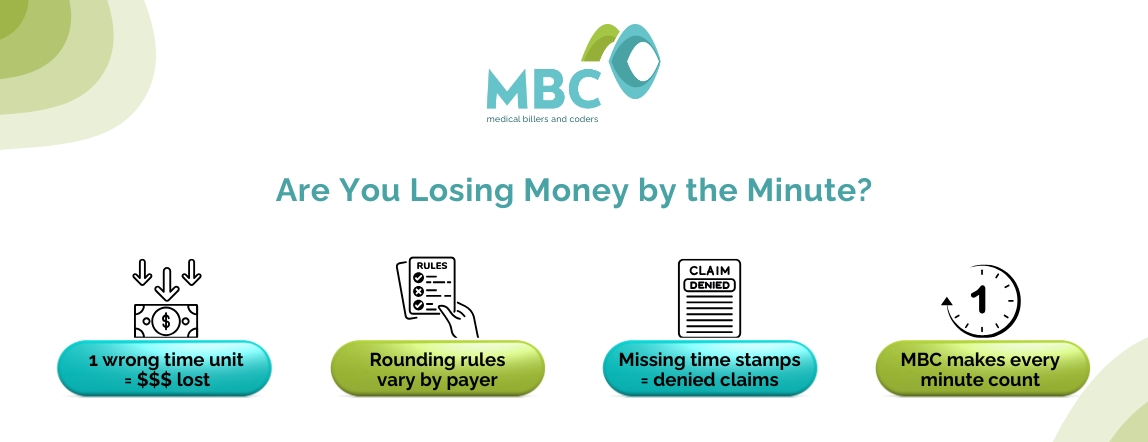
CMS and commercial payers define time units differently. One payer might round up after 7 minutes. Another won’t allow rounding at all.
If your billers aren’t dialed in, you’re likely underbilling or risking denials.
And when you’re managing multiple providers across facilities, the risk only grows.
Common Errors in Anesthesia Time Unit Calculations
Here are the mistakes we see most often:
1. Incorrect rounding practices
Not every payer follows the 15-minute = 1 unit rule.
2. Missing documentation of anesthesia start and end times
If times aren’t clearly noted, auditors may deny the entire claim.
3. Overlooking concurrency rules
Concurrency can change how time is billed for CRNAs and MDs. One misstep? Denied or reduced payment.
4. Assuming all payers follow CMS guidelines
Commercial payers have their own rules. Relying only on CMS can cost you.
Each of these issues impacts how many time units are billed—and how much you get paid.
The Cost of “Close Enough” in Anesthesia Billing
Many groups think they’re doing “well enough” with their billing. But even minor errors in unit calculation can lead to:
- Lost revenue per case
- Lower clean claim rates
- Increased audit risk
- Delayed reimbursements
Let’s do the math.
If you underbill just one unit per case, and you see 1,000 cases per year, that’s thousands of dollars lost—year after year.
How MBC Gets Time-Based Billing Right?
At MBC, we don’t cut corners. We analyze each anesthesia record down to the minute.
Here’s how we ensure you bill the right number of units, every time:
1. Dedicated Account Managers
We assign you a billing expert who understands your specific contracts, payer mix, and concurrency scenarios.
2. Data-Driven Analysis
Our team reviews time stamps and cross-checks with provider notes and EMR data to avoid rounding or concurrency errors.
3. Payer-Specific Rules
We maintain payer-specific billing guidelines to make sure each claim follows exact time unit policies.
4. Flexible Pricing Models
You only pay for what you need. No bloated overhead. Just precision billing that protects your bottom line.
Don’t Let Minutes Turn Into Missed Dollars
Time-based anesthesia billing is nuanced—but that’s exactly where MBC thrives. We handle the complexity so you can stay focused on outcomes, not paperwork.
If you’re questioning your unit accuracy—or worse, seeing lower-than-expected reimbursements—it’s time for a second look.
Schedule an audit today and let us show you how much you could be losing on time units alone.
FAQs
Time-based anesthesia billing calculates payment based on the length of anesthesia time plus base and modifying units.
Time units are usually calculated as one unit per 15 minutes. But rounding rules vary by payer.
Concurrency rules determine how time is billed when an anesthesiologist supervises multiple procedures. Misapplying these rules can lead to denials.
Each payer may define units and rounding differently. Accurate billing depends on knowing and applying each rule correctly.
Yes. We audit time units, apply payer-specific rules, and reduce denials—ensuring every unit is counted and reimbursed.
